
What Software Engineering Can Learn from Billions of Years of Evolution
Survival is not elegance. It is adaptation under pressure.

Nature has been running the longest continuous experimentation process in history.
For billions of years, living systems have been tested against reality. Traits that improve fitness in a given environment tend to persist. Traits that do not tend to disappear. Over enough time, that process produces systems that are not perfect, but remarkably capable.
That is part of what makes biology such a useful lens for thinking about software engineering.
The analogy is not perfect, and that matters. Evolution is not engineering. Nature has no roadmap, no architecture review, and no ambition to be elegant. Engineers can plan, model, refactor, and sometimes even start over. Even so, both biology and software involve complex systems shaped by constraint, feedback, environment, and time. In both worlds, the systems that last are rarely the ones that look best in theory. They are the ones that keep adapting under pressure.
There is a great deal software engineering can learn from that.
Reality Is the Feedback Loop
At its core, evolution is a feedback process. Environmental conditions reward some traits and penalize others. Over time, what proves more fit tends to persist.
Software also lives inside feedback loops, but the selection pressures are broader than engineering alone.
A technically excellent system can still fail if it is too expensive to support, too hard to sell, poorly timed for the market, misaligned with regulation, or abandoned by leadership. Software persists not only by being well engineered, but by being adopted, supported, funded, and maintained. Its environment includes far more than code.
Natural selection is production testing at planetary scale. Persistence is the success metric. Failure is selected against automatically in the next version. There are no architecture review boards in the forest. No steering committees in the ocean. No design documents that can argue their way around reality. There are only outcomes.
Nature does not debate architecture. It tests designs directly in production.
That idea is worth sitting with for a minute, because it gets at something many engineers eventually learn the hard way: theoretical elegance means very little if the system cannot withstand real conditions. A design can be beautiful in the abstract and still fail when it meets latency, load, misuse, entropy, or time. The real world is where ideas are promoted, demoted, or killed.
Biology has no option but to respect that. Every generation is a release. Every environment is a demanding user base. Every predator, disease, drought, injury, and shortage is a form of brutal integration testing. The organisms that persist are not the ones that looked most promising on a whiteboard. They are the ones that functioned under pressure.
Software systems are not different in principle. The systems that improve are the ones exposed to feedback, observed honestly, and changed in response to what actually happens. This is one reason experienced engineers tend to place less faith in perfect up-front design and more faith in tight loops of learning. They know that systems get smarter by surviving contact with reality, not by avoiding it.
Efficiency Emerges from Elimination
When people talk about biological efficiency, it can sound as if nature is purposefully designing streamlined solutions. That is not really how it works. Biological efficiency is not the result of a central planner. It is what remains after enough waste has been punished and enough fragility has failed.
Over long stretches of time, inefficient energy usage becomes expensive. Fragile structures fail under stress. Behaviors that consume too much and return too little disappear. What survives is not perfect, but it is often impressively economical.
This has always reminded me of great software engineers.
Some of the best engineers I have worked with have a habit that is easy to underestimate: they regularly delete more code than they add. Not because they are disengaged, and not because they lack ideas, but because they understand something fundamental about systems. Deleted code requires zero maintenance. It introduces no new branches, no hidden behavior, no future regression surface, no added operational burden. It does not need documentation updates. It does not wake anybody up in the middle of the night. It simply stops costing.
The net value of removing the wrong code is often greater than the net value of adding more.
There is something deeply evolutionary about that. Systems do not become efficient only by accumulating capabilities. They also become efficient by shedding what no longer improves their fitness. Pruning is a form of optimization. Constraint is a form of intelligence.
A system that can remove unnecessary complexity is healthier than one that continues to grow without discipline. Efficiency, however, does not mean stripping away everything that looks redundant. Some forms of apparent excess are exactly what make a system resilient under stress.
This is true in biology and software alike. Organisms do not need perfect metabolic systems. They need systems efficient enough to compete, survive, and reproduce. Software does not need idealized purity to be valuable. It needs to be robust enough, simple enough, and maintainable enough to survive real use and continue improving.
Evolution does not produce perfection. It produces systems fit enough to persist.
That distinction matters. Engineers can get trapped chasing ideal forms while ignoring practical fitness. But the systems that last are not necessarily the most theoretically beautiful. They are the ones that continue to function effectively in the conditions they actually inhabit.
Evolution Selects for Fitness, Not Elegance
In the early 2010s, I spent a few years studying biology with my eyes on medical school. At the time, I was burned out after about a decade of building software at a very large company, and I was seriously considering leaving the field altogether. I wanted to understand something more grounded, more human, maybe even more meaningful. Biology drew me in because it felt both concrete and profound. It was systems thinking, just in a different medium.
That season taught me a great deal, and not all of it came from formal coursework.
One line from a biology professor has stuck with me ever since. He joked that it is a good thing we do not have to consciously understand all of our biological processes for them to work, because if we did, we would all die. It was funny, but it was also true in an important way. Most of the critical systems keeping us alive operate beneath conscious awareness. We depend on them without fully comprehending them moment to moment.
That maps almost perfectly to abstraction in software engineering.
You do not need to understand the full complexity of every underlying layer in order to build useful things on top of it. In fact, if you had to reason from first principles all the way down every time, nothing of consequence would ever get built. You depend on operating systems, runtimes, frameworks, libraries, protocols, and infrastructure precisely because abstraction lets you focus on the problem at hand. You trust lower layers to behave consistently enough that you can move upward.
Biology works this way too. The organism does not need an awareness of cellular respiration to keep breathing, or a conscious model of electrolyte balance to maintain homeostasis. Abstraction is not just a software convenience. It is part of how complex systems remain usable at all.
At the same time, biology offers a humbling reminder that survivable systems are not always elegant systems.
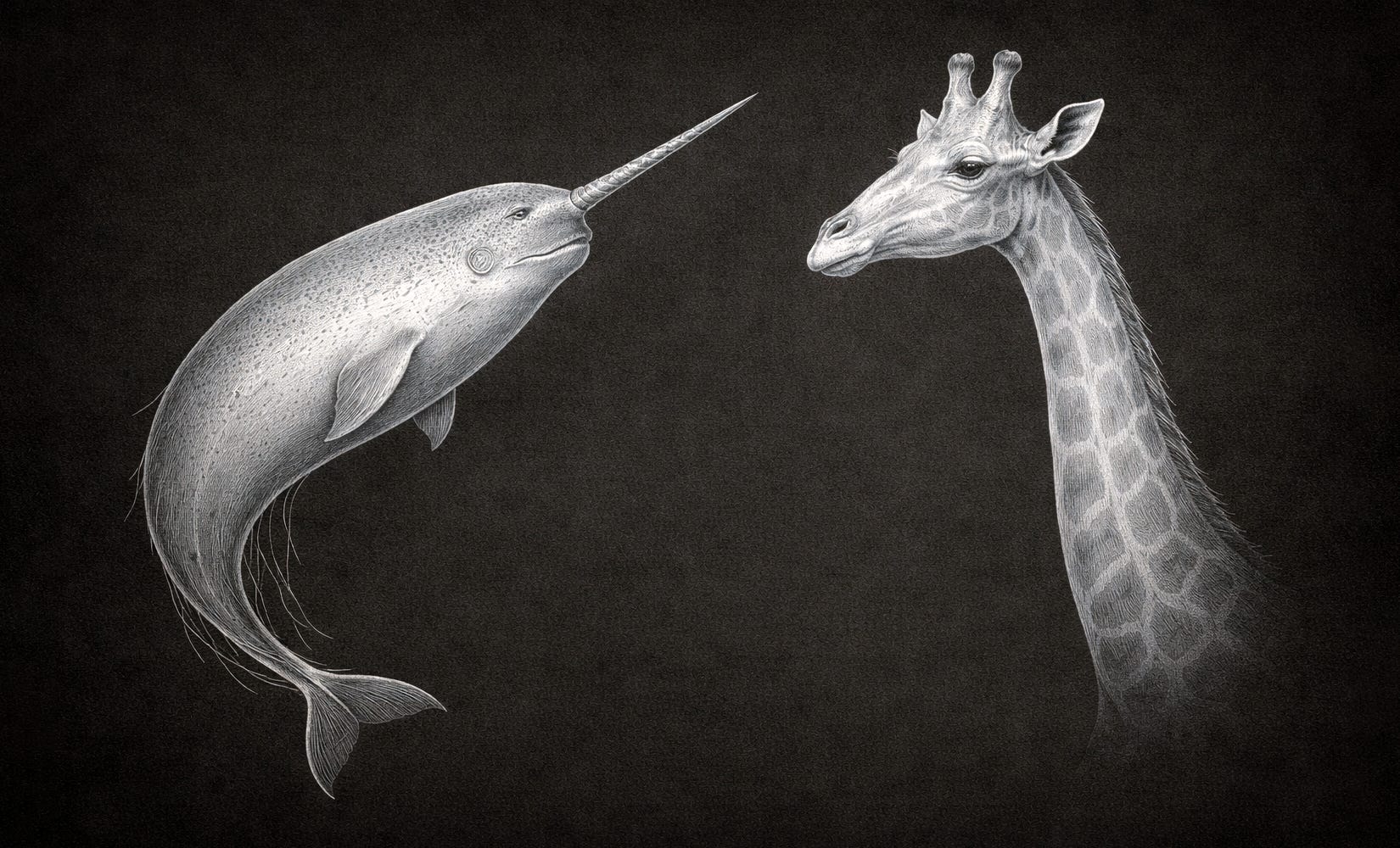
The human eye has a blind spot. The human spine is not especially well optimized for upright posture. The giraffe’s recurrent laryngeal nerve takes a famously indirect route that looks absurd if you approach it like a clean-sheet engineering exercise. These are not examples of nature “getting it wrong” in a simplistic sense. They are examples of nature working incrementally from what already exists.
Evolution does not start over. It modifies inherited structures.
That should sound familiar to anyone who has worked in real software environments.
Very few production systems are born in a vacuum. Most inherit old assumptions, interfaces, schema decisions, business rules, and architectural tradeoffs from earlier stages of life. New capabilities are layered on top of existing constraints. What exists today is often partly shaped by decisions that made sense years ago under completely different conditions. That is why production systems sometimes contain strange seams and unexpected compromises. They are not pure expressions of current intent. They are living records of accumulated adaptation.
Evolution never rewrites the codebase. In fact, it cannot. It patches what already exists.
That process can produce awkward structures. After all, the narwhal exists. It can also produce durable ones. There is a lesson there for engineers who feel the constant pull of the rewrite. Clean-slate thinking has its place, but most enduring systems evolve in place. They get better through careful adaptation, not through repeated acts of total replacement. It is as if nature read Refactoring by Martin Fowler well before Martin was even born.
Software has an option biology does not: it can attempt a true rewrite. Sometimes that is the right call. But rewrites often discard more than code. They discard edge-case knowledge, operational scars, and hard-won adaptations that are easy to overlook precisely because they are already embedded in the system. The old system may look awkward because it has survived reality. The new one may look clean because it has not.
Redundancy Is Not Waste
One of the most counterintuitive lessons biology teaches is that redundancy is often not waste. It is resilience.
Living systems contain backup after backup after backup. We have two kidneys. The immune system operates in layered ways. Cells contain repair mechanisms for damaged DNA. Metabolic pathways can compensate when preferred routes are unavailable. Again and again, biology behaves as if failure is not a remote possibility but a certainty that must be expected.
That is because it is.
Nature rarely trusts a single point of failure. More precisely, resilient systems preserve slack, optionality, and fallback capacity. Sometimes that takes the form of literal redundancy. Sometimes it looks more like flexibility.
For engineers, that should feel immediately recognizable. When we build distributed systems, retries, replication, fault domains, circuit breakers, graceful degradation, and fallback paths, we are expressing the same principle. We are admitting that components will fail, dependencies will wobble, networks will partition, humans will make mistakes, and the environment will not cooperate just because our design doc was tidy.
Resilience is not the absence of failure. It is the capacity to continue functioning in the presence of failure.
That distinction matters because there is often pressure in engineering organizations to mistake lean design for fragile minimalism. Teams strip out guardrails in the name of simplicity or cost, only to rediscover the value of slack and fallback capacity after an outage. Biology rarely makes that mistake. It has spent too long operating in hostile conditions to assume the happy path is enough.
In the real world, systems absorb stress. They bend. They degrade. They recover. Or they do not.
The ones that last usually have enough redundancy, flexibility, or fallback capacity to tolerate the entropy of reality.
Small Iterations Beat Grand Designs
Evolution advances through small changes. Variation appears. Some of it proves useful. That usefulness persists. Over time, change accumulates. The result, viewed across millions of years, can look miraculous. But the mechanism itself is remarkably incremental.
This may be one of the most important lessons engineering can take from biology.
Incremental development is often underrated because it lacks drama. It does not produce the same emotional payoff as a grand redesign or an ambitious declaration that everything is about to be rebuilt correctly this time. But small changes are usually easier to reason about, easier to test, easier to observe, easier to roll back, and easier to learn from. They create conditions in which understanding can keep pace with change.
That is how durable systems tend to improve.
Large rewrites are seductive because they promise relief from history. They offer a vision of starting over without the awkward compromises, the old abstractions, the strange seams, and the inherited debt. Sometimes a rewrite is necessary. More often, it becomes a fantasy that delays learning and increases risk. Systems disappear into long development cycles and emerge less grounded in reality than the thing they replaced.
Evolution never pauses for a rewrite.
It keeps moving, adjusting, selecting, and accumulating. That is not as satisfying as a heroic reinvention story, but it is how robust systems are usually formed.
And yes, there are bizarre exceptions. The platypus does feel a bit like the Pontiac Aztek of the animal kingdom. But even that oddity reinforces the larger point. Evolution is not pursuing aesthetic coherence. It is not trying to make sense to human observers. It is producing things that can survive in their environment, however strange the path may look from the outside.
Billions of Iterations Compound
When you step back and look at biological systems, the sophistication can feel overwhelming. Vision, immune response, cellular repair, metabolism, neural signaling, reproduction, adaptation. The sheer density of interlocking behavior is difficult to comprehend.
It is tempting to see that complexity and assume it must have originated from a single brilliant act of design. But biology points in another direction. The sophistication is cumulative. It is the result of change layered on change, pressure layered on pressure, and iteration layered on iteration across spans of time large enough to challenge intuition.
Time plus iteration produces emergent capability.
Engineering has its own smaller-scale version of this. Mature systems often look refined not because they were born that way, but because they have survived enough encounters with reality to become hardened by them. Every incident teaches something. Every constraint reveals a weakness or a tradeoff. Every release leaves behind lessons that shape the next one. Over time, the system becomes more capable not through purity, but through adaptation.
This is one reason seasoned engineers are often drawn to compounding improvements rather than dramatic overhauls. They know that robustness emerges from contact with the real world. A system that has survived many cycles of observation, correction, and use is often stronger than a theoretically superior system that has never been tested outside the lab.
The same principle applies beyond software. Teams improve this way. Organizations improve this way. Individuals improve this way. Small corrections, honestly observed and repeatedly applied, compound into something more sophisticated than any single leap could produce.
What Engineering Can Learn from Evolution
The more time I spend thinking about biology and engineering together, the more I am struck by how much they share. Both are shaped by constraints, tested by reality, and refined more by feedback than by theory. Both become more resilient through adaptation, and both accumulate complexity over time, for better and for worse. In the end, the systems that endure are rarely the flawless ones. They are the ones capable of continuing to function, adapt, attract support, and improve despite their imperfections.
That last point may matter most. Engineers are often drawn to elegance, and that instinct is not wrong. Elegance, clarity, and simplicity all matter. But none of them can be the ultimate objective if achieving them comes at the expense of survivability. A beautiful design that collapses under normal operating conditions is not a success. A slightly awkward system that continues to function and improve is.
Nature understands this intuitively. It is not trying to impress anyone or present a polished model of how things ought to work. It continuously selects for what works well enough to persist.
There is a humility in that. The system does not need to be ideal. It needs to keep going.
Conclusion
Biological systems are not elegant in the abstract. They are the result of billions of experiments.
Every generation is a test. Failures disappear from the next version.
Over enough time, that process produces systems that are remarkably effective. Not because they were designed perfectly, but because imperfection is constantly exposed to pressure, and what cannot hold up eventually gives way to what can.
Nature does not optimize for elegance.
It preserves what proves fit enough to persist.
A sharp analogy, especially the focus on fitness over elegance and real-world feedback over theory. The points on deletion as optimization and redundancy as resilience sound true, since “clean” systems often fail under real stress testing.
One thing I’m curious about: how do you think teams should decide when to tolerate evolutionary “patching” of a system versus making the call for a full rewrite? In biology, there’s no reset button, but in software, there is, at least in principle. What signals indicate that accumulated adaptations are still net-positive rather than becoming a constraint on future fitness?